
How to write a recommendation letter
A strong recommendation letter should explain the recommender’s relationship with the student, highlight key strengths with specific examples, and clearly show why the student is a strong fit for the opportunity.
Recommendation letter template
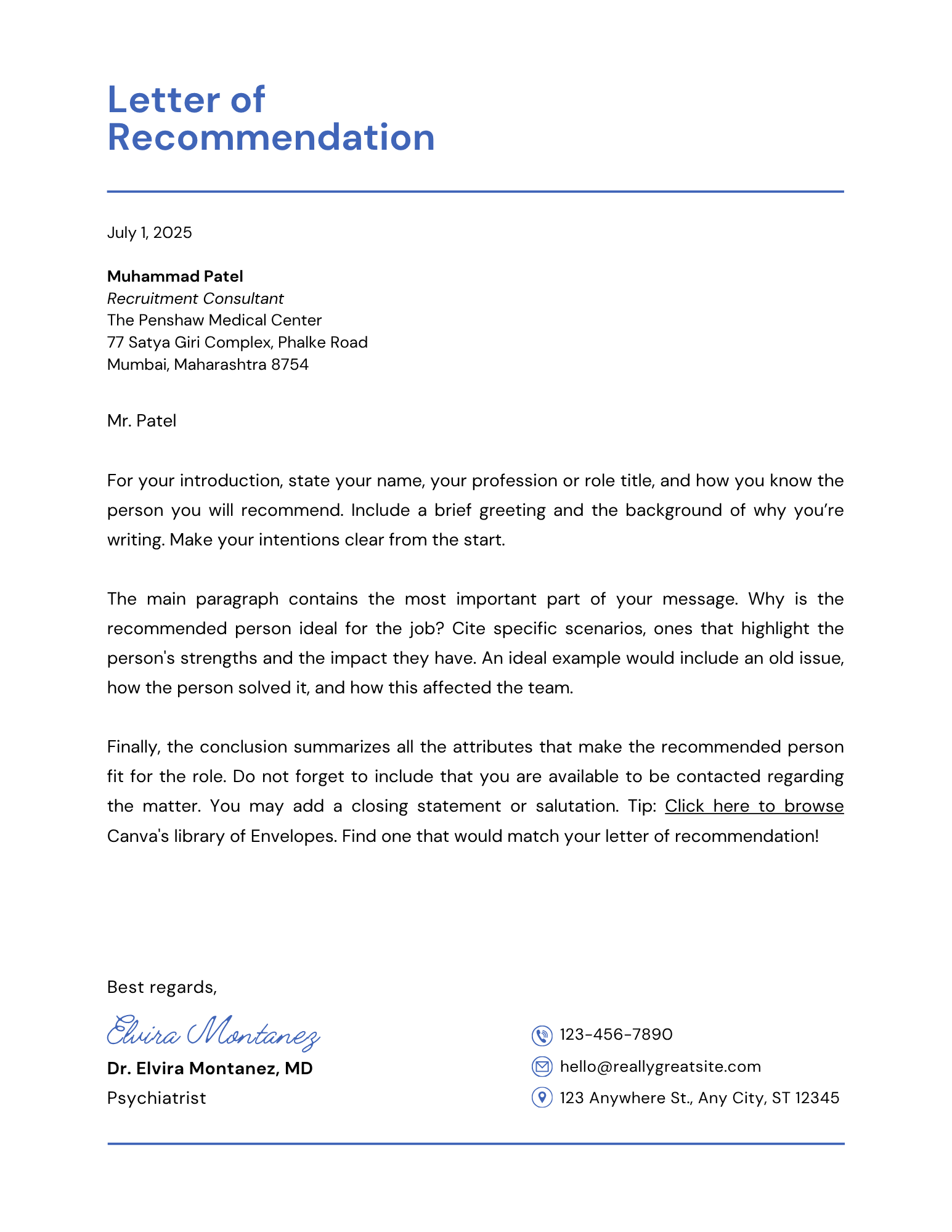
What to write in a recommendation letter
For your introduction, state your name, your profession or role title, and how you know the person you will recommend. Include a brief greeting and the background of why you’re writing. Make your intentions clear from the start.
The main paragraph contains the most important part of your message. Why is the recommended person ideal for the job? Cite specific scenarios, ones that highlight the person's strengths and the impact they have. An ideal example would include an old issue, how the person solved it, and how this affected the team.
Finally, the conclusion summarizes all the attributes that make the recommended person fit for the role. Do not forget to include that you are available to be contacted regarding the matter. You may add a closing statement or salutation.
Recommendation letter sections
| Section | What to write | Why it matters | Example |
|---|---|---|---|
| Relationship | Explain who you are and how you know the student | Establishes credibility and context | “I have taught Emma in two advanced strategy courses and supervised her thesis for one year.” |
| Duration | State how long you have known the student | Shows depth of observation | “I have known her for three years.” |
| Role and context | Describe the setting in which you worked with the student | Helps readers understand the basis of evaluation | “I worked with him as his research advisor in a data-intensive project.” |
| Academic or professional strength | Highlight the student’s strongest abilities | Gives the core reason for recommendation | “She stands out for analytical rigor and independent thinking.” |
| Specific achievements | Provide concrete examples and results | Makes the letter more believable and memorable | “He designed a survey instrument that improved our data collection efficiency.” |
| Personal qualities | Mention traits such as reliability, maturity, or initiative | Shows the student beyond grades or titles | “She is dependable, proactive, and thoughtful in team settings.” |
| Comparative evaluation | Compare the student with peers when appropriate | Signals how exceptional the student is | “He ranks among the top 5% of students I have taught.” |
| Fit for opportunity | Explain why the student matches the program, job, or scholarship | Connects strengths to the target opportunity | “Her research discipline makes her especially well suited for doctoral study.” |
| Growth potential | Describe future promise and capacity to develop | Helps decision makers assess long-term value | “I am confident she will continue to grow into a strong leader.” |
| Closing endorsement | End with a clear and confident recommendation | Leaves no doubt about your support | “I strongly recommend him without reservation.” |
| Contact offer | Invite follow-up if needed | Adds professionalism and openness | “Please feel free to contact me if further information would be helpful.” |
More Posts

How to Write a Strong Recommendation Letter That Stands Out
Learn how to write a strong recommendation letter with the right structure, specific examples, and clear endorsement that helps applicants stand out.


Why Some Recommendation Letters Are Unforgettable and Others Quietly Hurt Applicants
Discover why some recommendation letters stand out and why weak or vague letters can damage an application without the student realizing it.
Newsletter
Join the community
Subscribe to our newsletter for the latest news and updates